- Published on
Why Is One Horsepower Equal to Approximately 746 Watts? A Mathematical Proof
- Authors

- Name
- Sadaf Naeem
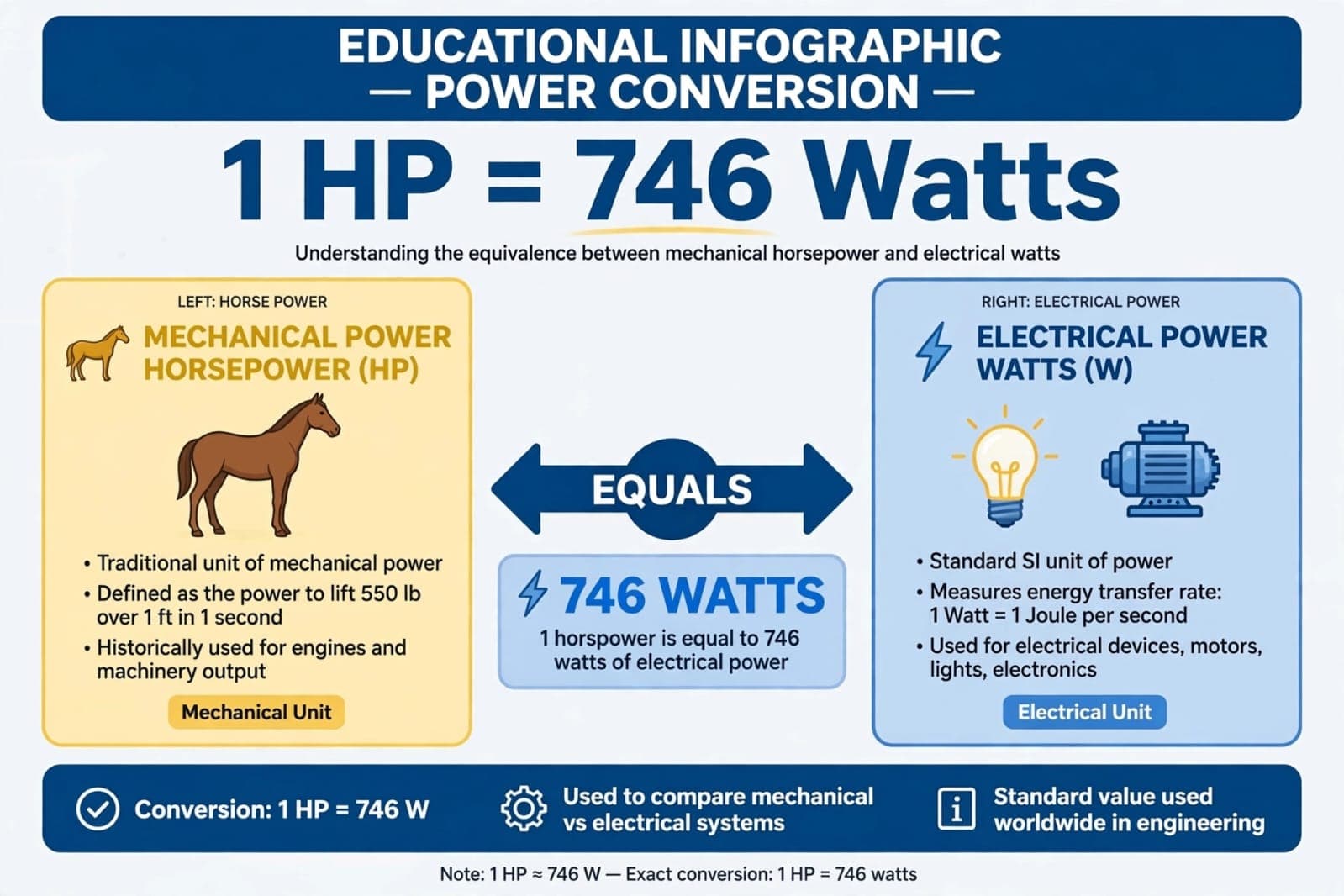
Why Is One Horsepower Equal to Approximately 746 Watts?
A Mathematical Proof by Sadaf Naeem
Class: First Year (Grade 11), Computer Science
Institution: Faith Horizon School & College, Baldher, Haripur
Introduction
You may have heard that an engine has a power of 1 horsepower (hp), but what does that mean in watts? The commonly used conversion is:
In this article, we will demonstrate where this number comes from using the definitions of power, work, and standard unit conversions.
Historical Background
The Scottish engineer James Watt popularized horsepower as a way to describe and compare the output of engines. Mechanical (imperial) horsepower is traditionally defined as the rate of doing 550 foot-pounds of work per second, or equivalently 33,000 foot-pounds per minute.
Our goal is to convert that definition into the International System of Units (SI), where power is measured in watts.
Step 1: Understand Power and Work
Power is the rate at which work is done:
For a constant force acting in the direction of motion, work is:
Combining the formulas:
Here, is power, is force, is distance, and is time.
One watt is one joule of work done per second:
Step 2: Start with the Definition of Horsepower
By the conventional imperial definition:
The symbol lbf means pound-force. It is important to distinguish pound-force from pound-mass (lb), because we must convert a force, not just a mass, into newtons.
Step 3: Convert the Units to SI
We use the following conversion values:
| Quantity | Conversion |
|---|---|
| Pound-mass | |
| Foot | |
| Standard gravitational acceleration |
A pound-force is the weight of one pound-mass under standard gravity. Therefore:
Now convert 550 pound-force to newtons:
Step 4: Calculate Power in Watts
Substitute the converted force and distance into the power formula:
Since :
Rounding to the nearest whole watt gives:
What Have We Proved?
Starting from the imperial definition of mechanical horsepower, we converted pound-force into newtons and feet into metres. By expressing work per second in SI units, we obtained 745.7 watts, normally rounded to 746 watts.
This is why textbooks and engineering calculations frequently use:
Scientific note: This calculation is for mechanical (imperial) horsepower. Metric horsepower is a different unit and equals approximately 735.5 watts.
Conclusion
Horsepower and watts both measure power, which tells us how quickly work is done. The calculation shows that the familiar conversion of one horsepower to 746 watts follows directly from the standard definition of mechanical horsepower and basic physical unit conversions.
Student Author: Sadaf Naeem
Class: First Year (Computer Science)
School: Faith Horizon School & College, Baldher, Haripur
Based on the student's handwritten mathematical explanation, with editorial improvements to language, notation, and scientific precision for publication.